On Breath
Breath is the first and last sign of life. It greets us at birth and leaves us at death; and inbetween those two pivotal moments, it is constantly present – quiet, steady, unobtrusive, and almost imperceptible. Yet, despite its presence, we rarely experience it consciously. Breath happens on its own, in the background of thoughts, words, desires, worries, plans, and emotions. It is a faithful companion to our actions and reactions, often neglected until something disrupts it. In moments of tension, inner unrest, or physical exhaustion, we become aware of both its fragility and its incredible powerful.
The phrase “to bring the breath into order” might sound a bit technical, like a breath control exercise. However, in my experience, it has a much deeper meaning. It does not refer to managing the breath and fixing it, but to establishing a relationship with it – one in which the breath is a mirror of the inner state, and also a bridge towards restoring one’s own balance. Breath is the only physiological function that is both autonomous and consciously accessible, and therefore it plays an exceptionally important role in the meeting of body and mind.
In this essay, I explore what bringing the breath into order means to me through three different, yet interconnected aspects: in everyday life, through the practice of zenyoga, and in meditation. Through personal experience, I try to explain how breath responds to inner tensions, how it reveals them, and how it gradually becomes a bond, a support, and a silent presence that enables wholeness. Not as a technique, but as a living experience.
Everyday Life
Breath is the first and last sign of life. With the first inhalation, we enter this world, and with the last exhalation, we leave it. “Each inhalation and each exhalation is one less breath in this life.” Between those moments, the first and the last, in a quiet, constant presence that mostly goes unnoticed, breath is the immediate witness of external and internal experiences and a clear reflection of our reactions to them. Precise, clear, and honest – if we listen to it, it reveals more than thoughts and words, more than analyses and judgments. It responds directly, often long before the mind manages to name or logically explain something.
That tremor, that almost imperceptible pause that arises in the body in an instant, is especially visible in moments when I feel fear, panic, or illness. Questions arise: What now? Where to go? How to escape my own skin? And while the mind searches for appropriate, familiar words and ways to describe the emotion, the breath has already spoken – it constricts, quickens, rises upwards, becomes loud, uncontrolled, fragmented, the chest begins to tighten, overwhelmed by heaviness, the whole body tenses and stops. Only then is it clear that the breath is not just a physiological function of the body, but a mirror – an immediate indicator of the inner state, a signal pointing towards what is happening within us. Faster than the body, faster than the mind, like a projector it shows a real picture of how connected we are to, or disconnected from, our own experience.
In such situations, I stop engaging with the content and cause of the emotions that arise, but instead try to turn my attention to the breath, exactly as it is in that moment, without trying to change or understand it. I “cling” to it as the only available exit and force myself into a conscious deep inhalation and prolonged exhalation. That first, forced breath opens the way for the next one, and then the next, after which the breathing itself gradually calms, regulates, and expands. With this expansion, the feeling of inner space slowly returns, where the emotion still exists but no longer dominates or controls the entire experience. Each new breath brings new freshness and brings me back home.
Practicing Zenyoga
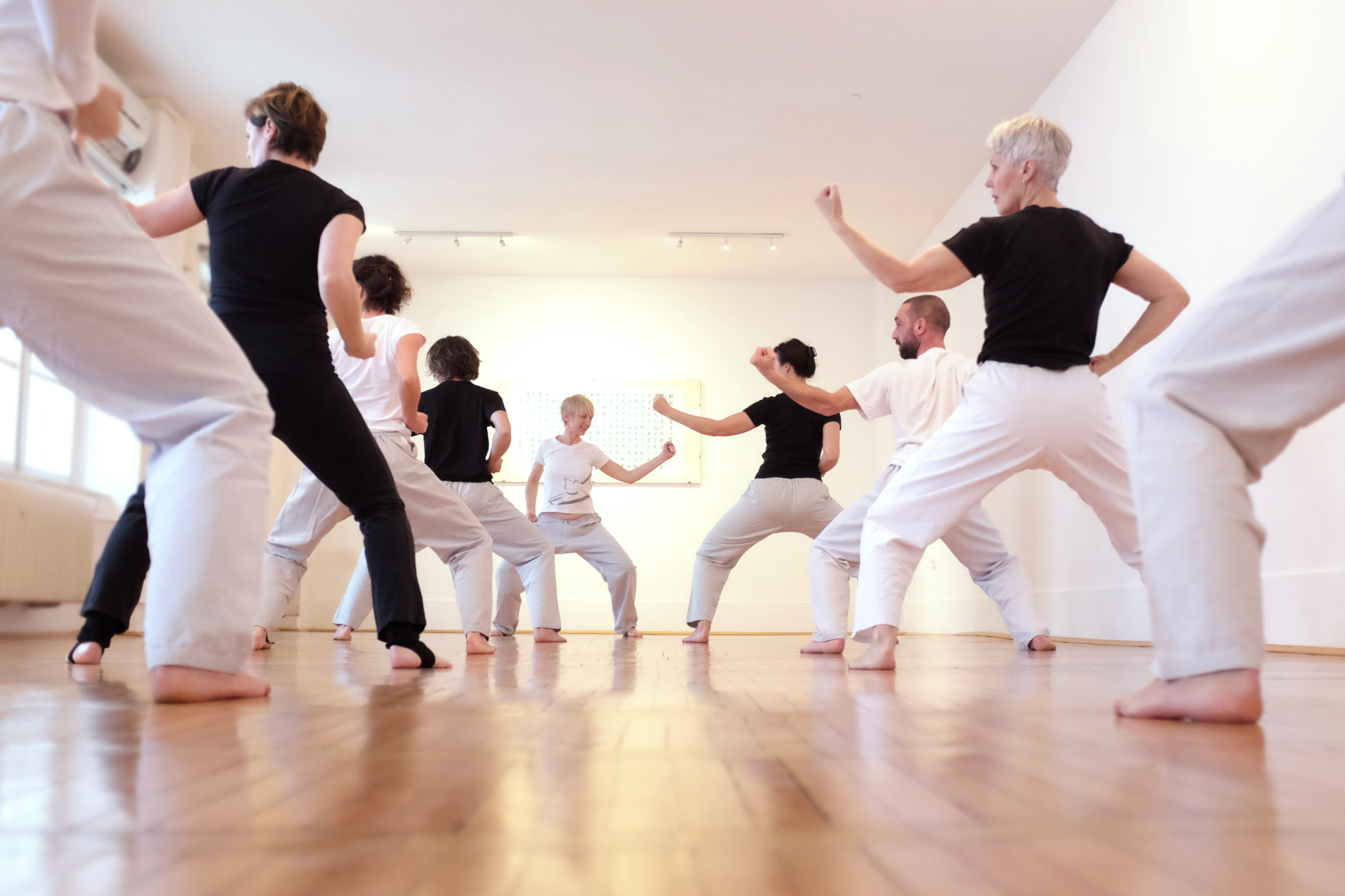
In the practice of zenyoga, the breath does not follow the movement, but completely determines it. The breath is not manipulated or held; instead, we strive to feel it directly and join it with the movement. When, during practice, I try to assume a certain position that seems unattainable, I often do not encounter the limits of my body, but the limits of my own relationship with my body. An idea appears of how the posture should look, or the feeling that I should already be able to do something given my years of practice, and tension arises almost instantly as a response to my own expectation.
The breath then withdraws, becomes short, fragmented, and insufficient; the body tightens, and the movement loses stability, form, ease, and clarity. But this is the moment and the place to direct attention – to the place of resistance, stiffness, constriction, and stagnation where the real physical and mental state is clearly recognized and mirrored. I bring the breath under the light of attention and remain in place for several inhalations and exhalations, allowing it to settle and be a reflection of presence in the body, just as it is, without trying to deepen or “fix” it, but with the clear awareness that I see, feel, and know what message it is sending me. In this stopping and non-doing, this accepting and ceasing to resist, the breath gradually calms, relaxes, deepens, and expands, causing the body to rearrange itself from within, begin to soften, and stop offering resistance. The breath brings new energy exactly where it is needed.
This is the moment when the breath begins to merge with the movement, permeate it, and directly influence its quality. This is the moment when the practice ceases to be strenuous and “difficult” and instead becomes healing movement and a joy that overwhelms the entire being. This is the moment when the practice ceases to be mere physical movement and transforms into yoga. A moment that forever changes my relationship with my body, with my breath, with my whole being.
A moment in which the body becomes a field for observing my own patterns: Where am I always rushing? Where am I comparing myself? Where am I pushing myself? Where am I trying to control? Where am I losing contact with my breath and myself?
A moment in which, perhaps for the first time, I directly see my physical limitations and have no need to intervene, but instead accept them and begin to treat them with respect. I begin to nurture them and approach them with special attention, because now I know where they come from and what lies behind them. I stop running away from uncomfortable, painful, and demanding places, because I know they are the loudest for a reason, that they need attention the most, that those postures are the most valuable for me and my different experience, that they move and erase boundaries. Entering them without fear and resistance to discomfort, unburdened by form and shape, being there with full attention and conscious breath, movement and breath permeate, complement, and harmonize each other, bringing one another into order. Zenyoga then ceases to be a physical practice and completely becomes meditation in motion.
Sitting Meditation
In sitting meditation, the breath opens up a completely new dimension of experience. Although some years have passed, I vividly remember my first attempt at meditating on the breath. A group of about 50 friends sat together in a hall on the island of Krk at a seminar symbolically named Spring Awakenings. I had been practicing yoga for some time and, seeking a new experience and deeper understanding, I signed up for the seminar.
After the introductory lecture given by the teacher, a guided meditation followed. The instructions he gave were clear: “Assume one of the traditional meditation postures…” He continued, guiding a detailed relaxation of the entire body, giving equal attention to each part. Everything went smoothly until the moment we leave the body sitting; calm and relaxed, and notice that the only thing moving is the breath. Breath? Which breath? Where is it moving? Where did it hide?
“When you inhale, know that you are inhaling, and when you exhale, attach a number from one to ten to each exhalation and repeat the cycle continuously. It is very important that you persist in bringing the mind back to the meditation method, every time you notice it has wandered,” the Teacher said in a calm tone in the distance.
And so, for the first time, I consciously stay with my breath. I count the exhalations. One, two, three.. The inner dialogue starts. I notice it and start again. One, two, three.. Someone outside honks. I start again. One, two, three… I’m hot. I start again. One, two, three… My back hurts. The entire meditation, my mind was occupied with everything and anything except the breath. Every number after three was unreachable for me. Despite my immense effort, it didn’t work. And precisely because it didn’t work, that early spring, a spark was awakened in me. At the first possible opportunity, I came to a meditation course.
I sat on the cushion again, assumed the posture most accessible to me at the time, calmed down, relaxed my body, and directed my attention to the breath. Shallow, unstable, fragmented, loud, elusive, held, insufficient… I steadfastly persisted in catching and counting, completely unaware that the breath is a mirror of the mind; that it is the mind that jumps around, playful, unstable, immensely interested in everything happening off the cushion. The breath merely reflects it and presents it. In that special moment of realization, the breath becomes a bridge between different parts of myself, a bridge that begins to connect me. It becomes a communication channel and an anchor that holds me together.
I count from one to ten, slowly let go of the counting. Only awareness of the inhalation and exhalation remains. I shift my attention to below the nostrils, to the place where cool air enters the body and warm air leaves it, increasingly softer, finer, gentler, barely perceptible.
Slowly, it fades from sensory experience and only a vibration remains, a vibration in the body that sits quietly and serenely. What remains is non-doing, which is not really nothing, but is everything. Harmony is established between body, mind, and breath. Harmony between the one who sits and the one who notices. What remains is peace, silence, joy, and an immeasurable expanse, unbounded by anything, indescribable in words. It is a return to what I am, not becoming something I am not.
To bring the breath into order does not mean to make it “correct,” deep, or calm, but to be aware of its presence and to allow it to show the truth it carries within itself from moment to moment. Each moment is new, unique, and unrepeatable, and the breath is there not to change it, but to point out that we have the ability to change our relationship to it. The breath requires no explanation, offers no solution, and promises no balance; it is what it is – a constant presence that reveals the “space” where body and mind meet, and loudly suggests “what is excess” that brings unrest. It is subject to change, impermanent and transient, but at the same time a healing and invaluable ally that transforms our experience from insufficient and burdensome into whole and pleasant, if we listen to it attentively.
R. V.
This essay is part of the final thesis for the School for Zenyoga Teachers